Featured Route
Why Adventure Riding in Bulgaria
Bulgaria is 111,000 km² — roughly the size of Iceland or Virginia — with four major mountain ranges running across it. The Stara Planina (literally "Old Mountain", and the source of the word "Balkan") cuts west-to-east down the middle. South of Sofia, the Rila and Pirin stack up against the Greek border with peaks over 2,900m. Between them and the Aegean sits the Rhodope — the most forested, least-populated range in the region.
Outside of the coastal strip and the three big cities, the country is quiet. Population density is among the lowest in the EU and the rural road network is enormous — Soviet-era forestry and agricultural tracks by the thousand, many now semi-abandoned. Fuel is cheap, food is excellent, and once you're off the A-road network you can ride for days without a traffic light.
The Terrain
The Balkan Mountain range itself — a wall of forested ridges, passes and gravel tracks running the full width of the country. Shipka Pass, Kotel, Vratnik: the historically significant routes cross here, but the best riding is on the unnamed forestry roads between them.
Forested mid-altitude range along the Greek border. Dense gravel network around Smolyan and Devin, old tobacco villages, and the Trigrad gorge. The quietest riding in the country — you can cover 80 km of forest track and see two cars.
The two alpine ranges south of Sofia. Paved passes are spectacular (the road up to Seven Rila Lakes, the Bansko approach), but genuine offroad is limited inside the national parks — stay on the park-service roads and you're fine. Best day trips from Sofia or Bansko.
When to Ride
Snow lingers on the high Stara Planina passes through April; the lower Rhodope tracks are usually rideable by late March. July and August are hot (35°C+ on the plains, cooler on the ridges) but the dry conditions make the dirt tracks fast. September and October are the best months — stable weather, golden beech forests, empty roads. November is a gamble: the south stays open, but the central Stara Planina can close without notice on the first snowfall.
How to Fit It Into Your Route
- → Romania → Bulgaria → Greece — the classic Balkan north-south. Drop off the Transfăgărășan or Transalpina, cross the Danube at Ruse, spend 4 days on Stara Planina, then head south through the Rhodope into Greek Macedonia. Two weeks, mostly offroad, minimal motorway.
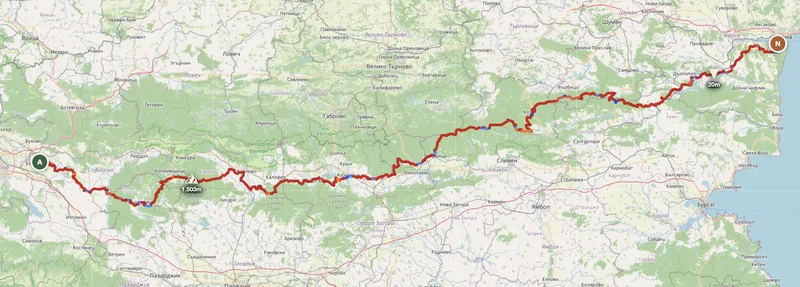
- → Coast-to-coast: Sofia → Varna — the route above, done west-to-east. Fly into Sofia, rent a bike, ride five days of Stara Planina dirt, finish in Varna or Burgas, drop the bike and fly home. Everything offroad, no backtracking.
- → Rhodope deep dive — for riders who want one region in depth. Base in Devin or Smolyan, 3–4 days of loop rides through the southern gorges and Greek-border forest tracks. Low altitude, long season, the most remote riding in the country.
Practical
Dense station network on the A-roads, but the Stara Planina and Rhodope offroad sections can go 100+ km between pumps. Fill up in every valley town you pass through. Prices are among the lowest in the EU.
Bulgarian lev (BGN) — pegged to the euro at roughly 1.95:1, so prices are easy to mental-math. Cards work in towns and at most fuel stations; cash is needed for village mehanas, monasteries and small guesthouses.
EU member but not in Schengen (as of writing) — expect ID checks at all land crossings. Romanian crossings at Ruse and Vidin are the main northern entries; Greek crossings at Kulata and Makaza work for south routes; Turkey via Kapıkule is the southeast exit.
Family-run guesthouses ("kashta za gosti") and mountain huts everywhere — often 20–30 EUR a night including dinner. Wild camping is legal outside national parks and widely tolerated. Sofia, Plovdiv, Veliko Tarnovo and Varna all have cheap hotel options.
Good coverage on all main roads and in every town. Dead zones start on the higher Stara Planina ridges (Kom–Emine traverse sections) and in the deeper Rhodope valleys. Download offline maps for the whole country before leaving Sofia.
Continental climate — cold winters, hot dry summers on the plains. Summer lowland temperatures regularly hit 35°C, but the ridges stay 10°C cooler. Afternoon thunderstorms build over the mountains through July and August; ride early, descend to a valley by 4pm.
Plan an offroad route in Bulgaria
Set your start near Sofia and your end in Varna or Burgas — GoraAdv routes you along the Balkan Mountain spine on mostly dirt track.
Open the Planner →