Featured Route
Why Adventure Riding in Spain
Spain is 506,000 km² — Europe's second-largest country after France, with a population of 48 million that concentrates on the Mediterranean coast, Madrid, and the industrial north. The interior is genuinely empty: the Meseta, the central plateau that covers almost half the country, has some of the lowest rural population densities in Europe. Add the Pyrénées on the French border, the Cantabrian Range along the north coast, the Sistema Ibérico and Sierra Morena across the middle, and the Béticas (Sierra Nevada, Cazorla) in the south, and you have a country that is 60% mountains and half of it barely inhabited.
For offroad riding, Spain is a near-perfect match. The legal network of caminos rurales — unpaved rural lanes — is vast, and most of it is open to registered motorcycles by default. Terrain ranges from green temperate Cantabrian forest to high pine sierra to near-desert badlands in Almería. Climate gives you three viable riding seasons. Few countries offer this much offroad for the distance travelled to get there.
The Regions
The green north — Atlantic-facing ranges with heavy forest, high limestone massifs (Picos de Europa), and a dense network of forest and mining tracks. Wetter than the rest of Spain; the riding is technical on clay after rain but magnificent in dry weather.
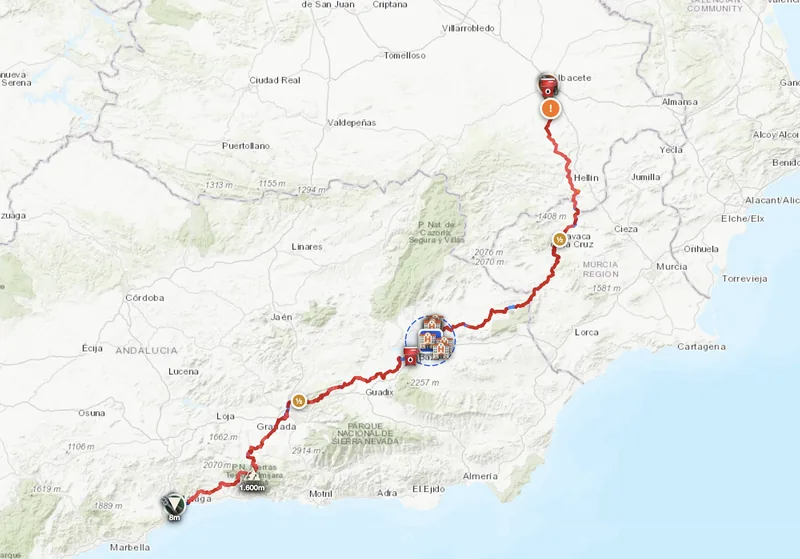
2,143 km² of protected sierra — pine forest, karst plateaus, deep river gorges. A dense forestry road network makes this the single densest legal offroad zone in Spain. The featured route above crosses the range from south to north.
The southern high country — Sierra Nevada holds mainland Spain's highest peak (Mulhacén, 3,479 m), and the white villages of the Alpujarra below it are the gateway. Ronda's serrania and the limestone sierras of Grazalema offer some of the most scenic offroad in the country.
When to Ride
Spain's riding season is longer than most of Europe but varies sharply by region. The southern sierras (Cazorla, Murcia, Granada's lower slopes) are rideable from March and stay open through November — summer heat, not snow, is the main constraint. The Cantabrian north is different: wetter and cooler, with the best conditions in May–June and September–October. The Pyrénées follow alpine timing — high passes only from late June through September. July and August in the south hit 38–42°C and bring strict fire-ban closures on many forest tracks; rideable very early morning but dangerous by midday. Avoid January and February everywhere — tracks are either frozen, muddy, or both.
How to Fit It Into Your Route
- → Iberian grand tour: Spain → Portugal → Spain — enter through the Pyrénées or over the Basque coast, loop south through Castilla–La Mancha into Portugal's Alentejo, climb the north of Portugal, return via Trás-os-Montes to Spain's Sanabria. 14–21 days for the full Iberian circuit on dirt.
- → Full Spanish north-south — Bilbao or Santander down through the Sistema Ibérico, Cazorla, Sierra Nevada to the Mediterranean. A cleaner version of the TET logic, 8–12 days, 2,000+ km offroad.
- → Ferry to Morocco — finish in Algeciras or Málaga, ferry across the Strait of Gibraltar into Tangier. Spain's south coast is the staging point for the classic Atlas Mountains run. Featured route above ends in natural ferry position.
Practical
Dense on main roads, sparse in the sierras and interior Meseta. Plan 100–150 km between stations inside Cazorla and in rural Castilla. Fill up whenever you pass through a town.
Euro. Cards accepted almost everywhere; rural casas rurales sometimes prefer cash. ATMs in every town of 1,000+ people.
EU and Schengen — open crossings with France, Portugal, Andorra. The Gibraltar crossing into the UK Overseas Territory requires passport check. Ferry to Morocco requires vehicle import paperwork and 15–30 minute customs queues.
Casas rurales (rural guesthouses) run 60–90 EUR for two with breakfast in the sierras. Albergues (hostels) along pilgrim routes are cheaper. Wild camping is officially restricted but generally tolerated one-night above treeline. Summer fire bans override everything.
Good on main routes and coasts; drops sharply in Cazorla, the deep sierras and the Pyrénées. Download offline maps before leaving populated valleys. Emergency number is 112.
Protected zones close tracks during high fire risk — typically July to mid-September, declared day-by-day. Check at park entrances (información del parque) and respect all "prohibido el paso" signs. Fines are serious.
Plan an offroad route in Spain
Set your start and end — GoraAdv routes you on caminos rurales and forestry tracks across the sierras and the Meseta.
Open the Planner →