Featured Route
Why Adventure Riding in Thailand
Thailand is 513,000 km² — most of it tropical plain and coast, but the north rises into a folded mountain province that bleeds into Myanmar and Laos. This is the offroad country: Chiang Mai, Chiang Rai, Mae Hong Son and Pai province, where elevations climb over 2,500m and rivers cut deep forested valleys. 70 million people live in Thailand, but the north is where hill-tribe communities — Karen, Hmong, Akha, Lisu — still farm the slopes, and their dirt access roads have become the adventure-riding network.
Riding here is unlike anywhere in Europe: year-round warm, almost no traffic once you leave the main valleys, cheap fuel and cheaper rooms. The flipside is the monsoon — May to October turns the dirt into clay and can close ridge tracks for days. Plan trips around the cool dry season (November to February) and the mountains deliver some of the best tropical offroad riding on earth.
The Regions
The gateway. A ring of mountains within 30 km of the old city, laced with temple access roads, bamboo-forest tracks and coffee-farm dirt. Doi Inthanon (2,565m) is a paved climb but the surrounding ridges are dense offroad country — enough for a week of day loops from a single Chiang Mai base.
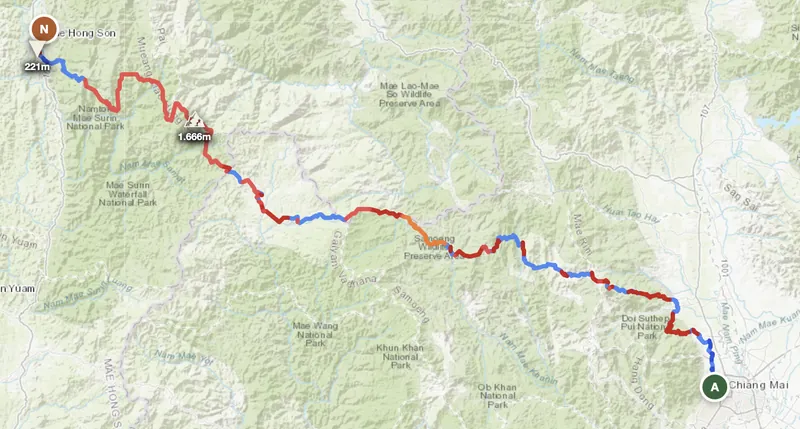
The remote northwest. Sparse population, deep valleys, and the famous 1,864-bend paved loop plus an equally long shadow network of forest tracks between Pai, Soppong, Khun Yuam and Mae Hong Son town. Expect river crossings in shoulder season.
Lower elevation but remote and agricultural — rice and tea terraces, red-dirt access roads, and riverside tracks along the Mekong. Less climbing than Mae Hong Son but longer, quieter days between villages.
When to Ride
The cool dry season — November to February — is the window: daytime 22–28°C in the north, cool nights in the mountains (down to 5°C at altitude), dirt bone-dry and grippy. March brings the hot-dry season (mid-30s) and the annual "burning" haze from agricultural fires blankets the north through April; visibility and air quality drop badly. May to October is monsoon — daily afternoon downpours turn ridge tracks into mud slides and can wash out sections. October is the tail end and can still be ridden, but with contingency for rain.
How to Fit It Into Your Route
- →Mae Hong Son Loop — the classic. Chiang Mai → Pai → Mae Hong Son → Mae Sariang → Chiang Mai. 4–5 days mixing the famous paved 1,864 curves with parallel forest tracks. The default first northern Thailand trip.
- →Golden Triangle extension — add 3–4 days running northeast from Chiang Mai to Chiang Rai, Mae Sai, then along the Mekong to Chiang Khong. Tri-border views into Laos and Myanmar, hotter and flatter than the Mae Hong Son side.
- →Fly-and-ride weekender — fly into Chiang Mai, rent a small dual-sport from one of the dozens of local rental shops, do 2–3 days of Doi Suthep + Samoeng loop without leaving the province. The cheapest serious offroad trip possible.
Practical
Petrol is cheap (roughly half European prices) and widely available. Every town of 2,000+ has a modern station; in the hills, village-scale pumps (often bottles on a rack) cover the rest. Plan 100–120 km between reliable stations in the far northwest.
Thai Baht. ATMs in every town charge a foreign-card fee (~200 THB). Cards work in cities and tourist hubs; rural villages, guesthouses and roadside food are cash only. Carry more than you expect to need in the mountains.
Visa-exempt 30 or 60 days for most Western passports on arrival. Rental bikes cannot be taken across land borders. Do not attempt the Myanmar side of the ridge — the crossings are closed to tourists and active conflict zones in places.
Guesthouses and bungalows in every hill town from 400–800 THB. Karen and Hmong village homestays are increasingly organised and cost about the same. Wild camping is legal and easy but rare — a bed and a hot shower costs almost nothing.
Surprisingly good across the north. 4G covers the main valleys and most villages. Ridge tops and deep forest sections drop out for 5–15 km at a time. Offline maps are essential — download the whole province in advance.
Hot year-round in the lowlands. November to February the mountains are the coolest place in the country — 20–28°C by day, 5–12°C at night above 1,500m. Pack a thermal layer for mountain mornings; it will feel absurd when you pack and essential at 6 AM.
Plan an offroad route in Thailand
Set Chiang Mai as your start and build a dirt line to Mae Hong Son — GoraAdv routes you through the forest tracks and hill-tribe roads of the north.
Open the Planner →