Featured Route
Why Adventure Riding in Italy
Italy is 301,000 km² of peninsula and islands, with two-thirds of it mountainous. The northern border is the Alpine arc — a 1,200 km curve from the French border to Slovenia holding dozens of 3,000m+ summits and the south face of the Dolomites. Running south from the Po basin, the Apennines form the spine of the mainland all the way to Calabria. Around 60 million people live here but they concentrate on the coasts and in the Po plain, leaving the mountains — especially the Apennines — genuinely empty.
For offroad riding, Italy punches above its weight. The Alps and Apennines both hold dense networks of legal forestry, military and agricultural roads, and the strade bianche (white gravel roads) of Tuscany and Umbria are a riding culture in their own right. Access rules vary region to region — some provinces are stricter than others — but the raw material is enormous. You can cross the country north-to-south or west-to-east on dirt without great effort.
The Regions
The French border range and the approach to Mont Blanc. High Alpine passes on old military roads (strade militari), including some of Europe's highest legally-ridable gravel. Short season — July to September at altitude — but the density of tracks above treeline is unmatched anywhere in the Alps.
Vertical limestone, forested valleys and a grid of well-maintained forestry roads that climb to the bases of the great walls. The Friulian Alps at the Slovenian border are quieter than the famous Dolomite heartland and hold some of the best forest riding in Italy.
Softer terrain — beech forest, pastureland, chestnut groves — laced with the white gravel roads Tuscany is famous for. Low elevation (peaks 1,500–2,000 m) means a much longer riding season than the Alps. Dense villages, short days between good food and good sleep.
When to Ride
Apennines and the Po plain open in April. The Alps hold snow on the high passes until late June — plan Alpine-arc routes for July to mid-September, when even the 2,500m+ military roads are clear. Midsummer on the plain and in Tuscany is hot (35°C+) but the mountains stay mild. September is the universal sweet spot: Alps still open, Apennines cooling, crowds gone. October is the last month at altitude — first snowfalls can come any time after the 15th. November through March the high ground closes, but low Tuscan and Apennine tracks can still be rideable between rain systems.
How to Fit It Into Your Route
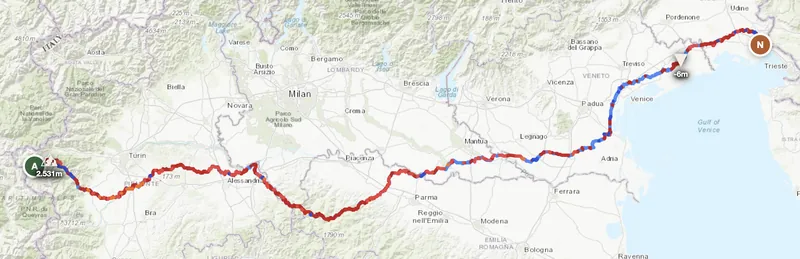
- → Full Alpine arc: France → Italy → Slovenia — chain the French Alps into the Italian Western Alps and Dolomites, then drop into Slovenia's Julian Alps. The featured route above is the Italian middle third. 10–14 days of continuous high-Alpine gravel.
- → Apennine spine end-to-end — Bologna to Calabria down the Apennine ridge, mixing strade bianche in Tuscany with the empty mountain parks of Abruzzo and the deep south. 7–10 days of mostly forest and pasture dirt, finishing at the toe of the boot.
- → Adriatic onward — finish the Alpine arc at Monfalcone and cross straight into Slovenia for the Julian Alps and Soča valley, or ferry from Ancona/Venice into Croatia for the Dinaric Alps. The east flank of Italy is a launchpad for the Western Balkans.
Practical
Dense in towns, thinner in the Apennine and Alpine interiors. Plan 100–150 km between stations in the mountains. Many rural stations are card-only after hours via self-service pumps. Prices on the higher end of the EU range.
Euro. Cards accepted almost everywhere, though small rifugi and mountain agriturismi often prefer cash. ATMs in every town of 3,000+ people.
EU and Schengen — open crossings with France, Switzerland, Austria and Slovenia. Slovenia is the natural gateway east to the Balkans; Switzerland charges a vignette for motorway use but backroads are free.
Agriturismi (farm stays) are the riding standard — 60–90 EUR for two with dinner in the Apennines, more in Tuscany and the Dolomites. Rifugi on the high Alpine routes offer bunk beds and dinner for 50–70 EUR. Wild camping is restricted; above treeline, a one-night bivy is generally tolerated.
Strong on the plain and in towns; patchy in the deep Apennine valleys and behind Alpine ridges. Download offline maps and cache the day's track before heading into the mountains. Emergency number is 112.
Offroad access rules vary by region. Some provinces (South Tyrol, parts of Piedmont) restrict motorised access on forest roads; others are open by default. Check local signage — strada militare and strada forestale designations, and any divieto di transito signs. National parks usually forbid offroad riding inside their core zones.
Plan an offroad route in Italy
Set your start in Piedmont and finish on the Adriatic — GoraAdv routes you across the full Italian Alpine arc on gravel and dirt.
Open the Planner →