Featured Route
Why Adventure Riding in Portugal
Portugal is 92,000 km² — a narrow country on the western edge of the Iberian peninsula, with a population of 10 million concentrated in the Lisbon and Porto corridors. The interior, especially the centre and northeast, is thinly populated and getting emptier every decade. Terrain rises from the Atlantic in steps: sandy coast, cork-oak and olive Alentejo, schist sierras across the Beira interior, and the high granite Trás-os-Montes in the northeast.
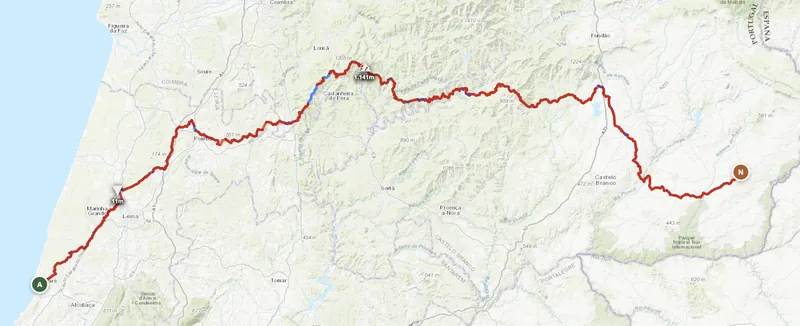
For offroad riding, Portugal is a quiet standout. The country has one of the densest legal offroad networks per square kilometre in Europe, grown out of rural forestry and farming tradition, and access is liberal by default. The climate gives two viable seasons (spring and autumn) with a mild Atlantic winter across the south. And because the country is narrow, you can genuinely cross it end-to-end on dirt in a week — the featured route above does exactly that.
The Regions
Rolling cork-oak and olive country across the Alentejo plain, dropping to sand and schist ridges near the south coast. Wide, dry, empty — villages 20–30 km apart. Rideable from March to June and again in October–November; summer is brutal and fire-restricted.
The spine of central Portugal — schist and granite sierras including Serra da Estrela, the country's highest mainland range. Dense forest roads, pine plantations recovering from the 2017 fires, and high open paramo above 1,500 m. Weather changes fast at altitude.
"Behind the mountains" — Portugal's wildest corner, a granite plateau pressed up against the Spanish border. Old villages, terraced hillsides, Montesinho and Douro Internacional natural parks. Low traffic, low tourism, medieval-feeling landscape. The finishing ground of the featured route.
When to Ride
Spring is Portugal's prime season — April to June gives you dry tracks, mild temperatures and the country at its greenest before the summer burn-off. The north (Trás-os-Montes, Minho) is wetter and cooler year-round; expect mud on lower tracks after any rain in spring. Summer is divided: the south and Alentejo hit 40°C+ in July and August — manageable early morning but dangerous by midday, and fire bans close many forest tracks. The northern highlands stay pleasant at altitude. September and October are excellent across the whole country. Winter brings heavy rain to the northwest and occasional snow on Serra da Estrela; the Alentejo stays mild but tracks turn soft.
How to Fit It Into Your Route
- → Full Iberian circuit: Portugal → Spain → Portugal — the featured south-to-north traverse connects directly into Galicia and on across the Spanish Meseta. Loop back via Extremadura and the Alentejo for a 2–3 week Iberian grand tour on mostly dirt.
- → Weekender from Lisbon or Porto — both cities are 60–90 minutes from serious offroad. Lisbon gateways into the Alentejo and Serra de Mértola; Porto gateways into the Douro and Peneda-Gerês. Fly in, rent a bike, ride 3–4 days without moving hotel base more than twice.
- → Ferry to Morocco — from Faro or Lisbon connect south via Spain's coast to Algeciras, ferry into Tangier. Portugal is a quieter, cheaper springboard than Spain for the Atlas run.
Practical
60–80 km gaps in the Alentejo interior and Trás-os-Montes. Fill up in towns before heading into forest sections. Cards accepted everywhere; rural stations often self-service after dark.
Euro. Cards accepted almost universally; rural aldeias and mountain quintas sometimes prefer cash. ATMs in every town of 2,000+ people.
EU and Schengen — fully open border with Spain. No checks, no paperwork. Ferry to Morocco is simplest via Algeciras on the Spanish side; Portuguese ferries to Africa are limited.
Turismo rural and quintas run 50–80 EUR for two with breakfast. Pousadas (state-run historic inns) are pricier. Wild camping is officially restricted but tolerated in forested interior if discreet; summer fire bans override this.
Good on main routes but drops in remote Trás-os-Montes and the Alentejo interior. Download offline maps before heading inland. Emergency number is 112.
Unpaved rural tracks are open by default to registered motorcycles. Many tracks cross private forestry — if gated, backtrack. National park core zones (Peneda-Gerês) restrict motorised access on marked trails. Respect fire-ban signage in summer.
Plan an offroad route in Portugal
Set your start and end — GoraAdv routes you on forestry and rural tracks from the Algarve to the Trás-os-Montes highlands.
Open the Planner →