Featured Route
Why Adventure Riding in Brazil
Brazil is the only country where you can ride 4,000 km in a straight line and never leave dirt. 8.5 million km² covers four major biomes — the cerrado plateau across the central highlands, the semi-arid sertão of the northeast, the Atlantic Forest along the eastern coast, and the Pantanal wetlands and Amazon rainforest in the west. Between them runs an extraordinary network of farm tracks (estradas vicinais), ranch roads, mining roads, and unpaved municipal links — most of them invisible on highway maps but completely ridable.
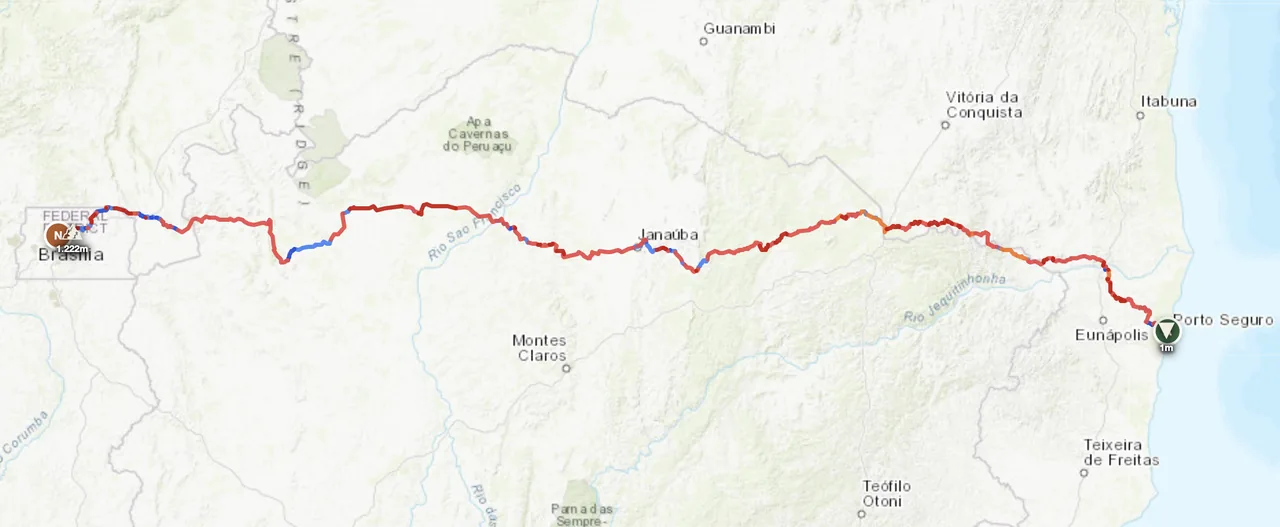
For the rider, Brazil rewards commitment. The country is too big to "see" — you pick a region and immerse for two or three weeks. Fuel is cheap and stations are dense around towns. People are warm and curious about motorcycles. The catch is logistics: distances are continental (Brasília to Porto Seguro is roughly Madrid to Berlin, and that's a single state-pair), the language is Portuguese (not Spanish — bring an offline translator), and the wet season turns the best dirt into impassable mud. Plan the dry months, pick a region, and the country gives more than you can ride.
The Zones
Brazil's "savanna." High plateau covered in grass, scrub, and gnarled trees. Endless dirt — farm and ranch tracks run for hundreds of kilometres parallel to the paved highways. Best dry-season May–Sep. Wet season turns the red earth (terra roxa) into deep clay that locks up wheels.
The chapadas are flat-topped table mountains rising 1,000 m+ out of the surrounding sertão — riddled with canyons, waterfalls, and 4×4 tracks that turn into challenging dirt for two wheels. Diamantina (Bahia) and the Mesas (Maranhão) are the two best-known. Dry, hot, dramatic.
The strip of remnant rainforest squeezed between the inland mountains and the Atlantic. Palm-lined dirt roads connecting fishing villages, small farms, and beaches. Hot and humid year-round; rain falls all year but Apr–Aug is the lighter window. Ferries and short coastal hops add character.
When to Ride
Brazil's offroad year revolves around the cerrado dry season. May through September is the window where dirt is dry, fords are crossable, and humidity drops to bearable. October and November are shoulder months — the rains start but tracks usually still go. December through March is the rainy season across most of the country: red earth turns to clay, fords become rivers, and many secondary tracks shut completely. The Atlantic coast and the south (Rio Grande do Sul) ride year-round, and the Pantanal in the west reverses the calendar — ride the dry season May–Sep when the wetlands recede and tracks emerge. February is exceptional for the coast (Carnival season, dramatic skies) but a hard no for the cerrado interior.
Regions to Plan Around
- → Cerrado crossing — Brasília as base, ride east through Goiás and western Bahia toward the Atlantic. 7–10 day window, best May–Aug. Dense farm-track network, sparse fuel — plan tank ranges carefully.
- → Chapada Diamantina loop — Salvador or Lençóis as base, 5–7 day loop through the canyons, waterfalls and dirt tracks of the chapada. Hot and dry; bring more water than you think.
- → Atlantic Forest coast — Rio de Janeiro to Salvador via the BR-101 alternative inland tracks. 10–14 day southbound or northbound run with ferries, beach access, and dense palm-track networks. Year-round but Apr–Aug is the cleanest weather.
Practical
Stations widely available on highways and around towns. Most stations carry both gasoline and ethanol (E100, "alcool") — most modern bikes run gasoline only, so always specify. Cerrado interior and chapadas can have 100–150 km gaps. Carry extra fuel for the longer offroad sections.
Brazilian real (BRL). Cards work in cities and most highway-corridor towns. Cash only in rural interior, sertão villages, and for fuel in remote stations. ATMs are common in towns; carry a few hundred reais for the rougher stretches.
Tourist visa-free for most western passport holders (varies by nationality — check before you go). Vehicle import is straightforward at land borders with a CTV (Certificado de Trânsito do Veículo). Brazilian motorcycle insurance (DPVAT) is mandatory; arrange via a local broker or at a border office.
Pousadas (small B&Bs) are the rider's best friend — every town has them, prices are reasonable, and parking is usually secure. Camping in national parks is permitted with a permit. Wild camping is fine in remote areas with permission from the landowner — Brazilians are warm to motorcycle travelers.
Coverage is strong on highways and around towns. The cerrado interior, sertão and Pantanal can have 100+ km without any signal. A satellite messenger (Garmin inReach or similar) is essential for solo crossings — there are stretches where you're a full day's ride from the nearest help.
Coastal humidity hits 30–35°C year-round; cerrado plateau is warm by day and cool at night (sub-15°C in winter); sertão is dry-hot 35°C+ daytime; the Pantanal is brutal humid heat in the wet and bearable in the dry. Always pack rain gear — wet-season storms are sudden and violent regardless of season.
Plan a Cerrado crossing
Set your start in Brasília and end at the Atlantic — GoraAdv routes you through the densest farm-track network in the Americas, automatically.
Open the Planner →