Featured Route
Why Adventure Riding in Hungary
Hungary is 93,000 km² of Carpathian Basin — mostly flat plain, but with a wooded northern rim of low mountain ranges (200–1,014 m) that form the offroad spine of the country. Population 9.6 million, with Budapest holding a fifth of it, meaning the north and east are thinly settled and the forest roads stay quiet. Hungarian — unrelated to any neighbour's language — is the local tongue, though most roadside hospitality runs on pointing, smiles, and translation apps.
For offroad riding, the action is the "Northern Highlands": the chain of Zemplén, Bükk, Mátra, Cserhát and Börzsöny. State forestry maintains a thick web of service roads that are legally ridable, and the Great Hungarian Plain below them adds hundreds of kilometres of agricultural dirt tracks if you want flat, fast miles. The northern ranges climb; the plain rolls. Together they make a country that is easy to get to, cheap to ride in, and surprisingly empty once you leave the Budapest orbit.
The Regions
Hungary's least-visited range, up against the Slovak border. Oak and beech forest over old volcanic cones, vineyards on every south slope, and a dense forestry network linking wine villages like Erdőbénye and Hollóháza. Ride, eat, sleep for the price of a Budapest coffee.
The largest block of continuous forest in Hungary. The Bükk plateau is a high (800m+) limestone karst riddled with caves and forestry roads; the Mátra next door holds the country's only real mountain road climbing to Kékes. Expect long ridge runs, cool air in summer, and almost no traffic.
The westernmost range of the Northern Highlands, wrapping the Danube Bend where the river turns 90° south. Tight volcanic hills, forested to the ridgelines, riddled with service roads. The closest serious offroad to Budapest — a half-day's ride from the city centre to the heart of the range.
When to Ride
Spring melts out the forest tracks by mid-April. May and June are the sweet spot — everything green, cool air in the Bükk, long evenings. Midsummer on the plain gets brutally hot (35°C+) and dusty, but the northern ranges stay 5–8°C cooler under the canopy. September is the classic month: warm, dry, harvest in Tokaj, the clearest air of the year. October is rideable but shortening daylight and the first frosts by month's end. November to March is off — cold, wet, muddy, and the forest service roads turn into bogs.
How to Fit It Into Your Route
- → Carpathian loop: Hungary → Romania → Serbia — the big eastern circuit. Traverse Hungary's northern highlands, drop into Transylvania through Nagylak, cross the Apuseni and Făgăraș in Romania, return via Serbia's Vojvodina plain. 10–14 days, a genuine Carpathian rim tour.
- → Central European forest tour — string Hungary with the ranges to the north: Slovakia's Low Tatras, Czech Beskydy and Bohemian highlands, back around through Poland. Cheap, easy border crossings, endless forest. 7–10 days across four Schengen countries.
- → Budapest weekender — fly into Budapest, rent a bike, do the Börzsöny and Danube Bend over 2–3 days without moving hotel base. The closest serious offroad to any major Central European airport.
Practical
Dense and cheap by EU standards — pumps in every village of 1,000+ people. Plan for 80–100 km between stations inside the forested ranges. Cards universally accepted; prices among the lowest in Central Europe.
Forint (HUF), not Euro. Cards work everywhere in towns; rural guesthouses and mountain huts often prefer cash. Exchange at any bank or draw from ATMs — avoid airport booths. Roughly 400 HUF to 1 EUR.
EU and Schengen — open crossings with Slovakia, Austria, Slovenia. Non-Schengen borders with Romania, Serbia, Ukraine and Croatia mean passport stops and occasional queues. The Ukrainian border is in a war zone; avoid entirely.
Village guesthouses (panzió) run 40–70 EUR for two, breakfast included. Thermal-bath hotels along the plain are a cheap luxury. Wild camping is technically illegal but tolerated in the forested ranges if you are discreet and pack out everything.
Solid across the plain and towns; the Bükk plateau and Zemplén ridgelines have dead zones of 10–20 km. Download offline maps and cache the day's track before dropping into the forest. Emergency number is 112.
Continental — hot summers (28–35°C on the plain), crisp autumns, cold winters. The northern ranges run 5–8°C cooler than Budapest. Thunderstorms build on summer afternoons and can turn forest tracks into clay traps within minutes.
Plan an offroad route in Hungary
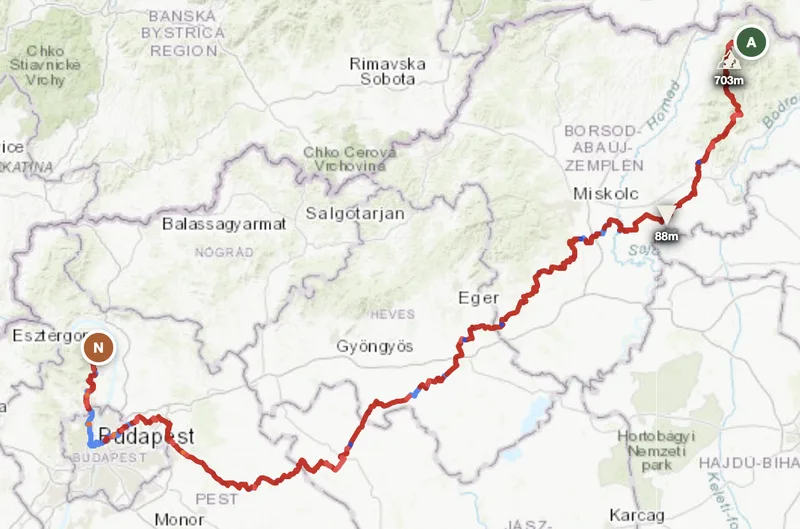
Set your start in the Zemplén and finish at the Danube Bend — GoraAdv routes you across four Hungarian ranges on state-forest gravel.
Open the Planner →