Featured Route
Why Adventure Riding in Czech Republic
The Czech Republic is 79,000 km² of rolling forest and hills wrapped inside a ring of low mountains — the Šumava to the southwest, the Krušné hory in the north, the Krkonoše on the Polish border, and the Jeseníky and Beskydy in Moravia. The interior is the Bohemian-Moravian Highlands (Vysočina) — hardly any of it above 800m, but almost all of it forested. 34% forest cover is among the highest in Central Europe.
What makes it work for ADV is the forestry network. Managed woodland means a dense, maintained web of gravel and dirt service roads — legally ridable, open to traffic, and rarely busy. Combined with a first-world infrastructure (good fuel, cheap accommodation, fast hospitals), a moderate season (April to October) and a small enough footprint that you can cross the country in a long weekend, it's one of Europe's most underused offroad destinations.
The Terrain
The Bohemian Forest along the German and Austrian frontier — Central Europe's largest unbroken forest. National park regulations limit engine access inside the core, but the peripheral logging network and the old Iron Curtain service roads are rideable and largely empty.
The rolling highland belt between Bohemia and Moravia. Not dramatic, but criss-crossed by thousands of kilometres of forestry tracks that connect fishpond valleys, single-church villages and medieval castle ruins. The easiest offroad in the country, good for shoulder season.
The two highest ranges — Krkonoše ("Giant Mountains") in the north and Jeseníky in the east. More alpine character, exposed ridges above the tree line, and steeper forestry tracks. Snow lingers into May; the short summer season makes these the payoff ranges.
When to Ride
The low-altitude majority of the country is rideable from early April through late October in a normal year. The Krkonoše and Jeseníky ranges hold snow into May above 1,200m and close roads on early snowfall from mid-October. July and August are warm and dry but the forest tracks can get busy with local cyclists and hikers on summer weekends. The sweet spot is mid-May through June, or the last two weeks of September — stable weather, long days, and almost no traffic.
How to Fit It Into Your Route
- → Germany → Czech → Slovakia — the classic Central European offroad axis. Cross from Bavaria into Šumava, traverse to Moravia, carry on into the Tatras. 10 days, mostly gravel, no language barrier worth mentioning.
- → Czech → Poland Krkonoše loop — cross into Poland at Harrachov and ride the Polish side of the Krkonoše/Karkonosze down to Szklarska Poręba, then back via Kłodzko. Two countries, one massif, a long weekend.
- → Prague weekender — fly into Prague, rent a bike, ride the Vysočina forest tracks in an out-and-back loop. 2–3 days, no border crossings, entirely T1/T2 once you leave the motorway ring.
Practical
Excellent network — never more than 30 km between stations anywhere in the country. Fuel prices sit slightly below the EU average. All stations accept cards.
Czech koruna (CZK), not the euro. Cards are accepted almost everywhere urban and in chain fuel stations; cash is useful for village pubs (hospoda), small guesthouses and mountain huts. Euros are sometimes accepted near the German border at a poor rate.
Schengen area — no border checks from any neighbour (Germany, Austria, Poland, Slovakia). Vignette required for motorcycles on motorways but NOT on secondary roads or any of the routing this planner generates; you don't need one for an offroad-only trip.
Pensions, mountain huts (chata/bouda) and small family hotels everywhere — typically 30–50 EUR a night with breakfast. Wild camping is technically illegal but tolerated when discreet, away from tourist trails. Every forest district has designated bivouac sites.
Good to excellent everywhere — one of the best coverage levels in the EU. Rare dead zones in the deeper Šumava and Jeseníky valleys. Offline maps still worth downloading for the forestry-track sections where satellite view helps more than phone data.
Continental climate — cold winters, warm summers. Summer highs rarely exceed 28°C; afternoon thunderstorms common in June and July. Forest tracks drain slowly after heavy rain — expect 1–2 days of mud after summer storms before they firm up.
Plan an offroad route in Czech Republic
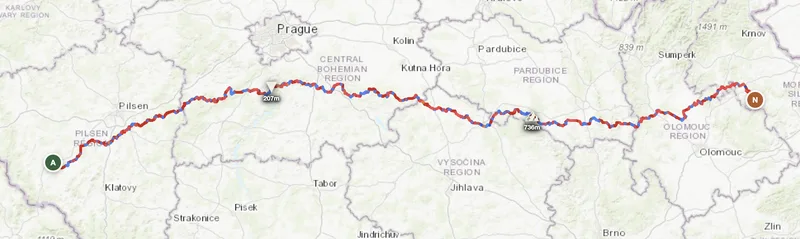
Set your start near the German border and finish in Moravia — GoraAdv routes you through the full length of the Czech forest network on gravel and dirt.
Open the Planner →