Featured Route
Why Adventure Riding in Montenegro
Montenegro is 13,800 km² of mountain stacked between the Adriatic and the Albanian border. Four of its five national parks are high ground — Durmitor, Biogradska Gora, Prokletije, Lovćen — and the coastal strip, narrow as it is, climbs to over 1,700m within 15 km of the sea. Every ride inland is a ride uphill.
The road network hides the good stuff. Between the two or three paved arteries connecting the capital to the coast and the north, there is a dense, underused web of gravel shepherd tracks, forestry roads and old Yugoslav-era mountain passes that sees almost no traffic from April through November. It's the easiest country in the Balkans to ride offroad all day without meeting another vehicle.
The Terrain
The plateau around Žabljak — black pine forest, glacial lakes and the P14 Sedlo Pass at 1,907m. Gravel loops skirt the base of Bobotov Kuk and drop into the Piva reservoir on the west side. Snow-clear from late May to October.
The most remote corner of the country — the "Accursed Mountains" shared with Albania and Kosovo. High karst plateaus, shepherd tracks and forest-service roads above Plav and Gusinje. Fewer sealed roads than Durmitor, higher reward, much higher chance of being the only bike out there.
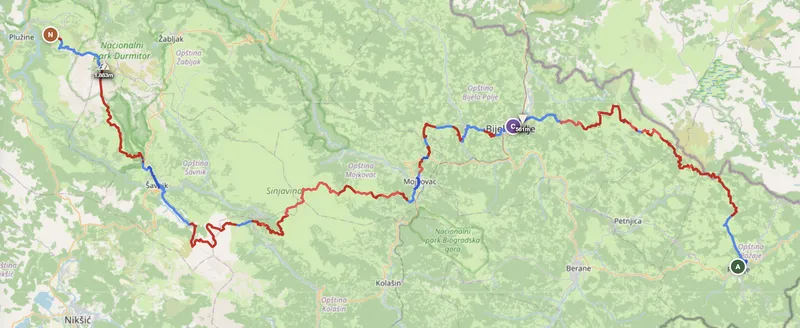
The 82 km Tara river gorge cuts across the north of the country. Gravel roads on both rims give dirt-track traverses between Mojkovac and Šćepan Polje, crossed by the single-lane Đurđevića Tara bridge — built in 1940, still the landmark shot of the region.
When to Ride
Durmitor and Prokletije hold snow into May — the high gravel passes above 1,800m aren't reliably clear until late May or early June. July and August are peak season on the coast but the mountains stay empty; you can ride the Durmitor loops in August and see more chamois than cars. September and October are the sweet spot: dry tracks, cool air, golden beech forests, and the tourist coast has emptied out. November is viable in the south but the passes close on the first serious snowfall without warning.
How to Fit It Into Your Route
- → Montenegro → Albania → North Macedonia — the southern Balkan triangle. Enter from Dubrovnik, ride Durmitor and the Tara, drop south through Prokletije into Albania's Valbona valley, and finish in Macedonia. A week of offroad with minimal motorway.
- → Croatia → Bosnia → Montenegro loop — ferry into Split, ride the Dinaric Alps across Bosnia, cross into Montenegro at Šćepan Polje, loop Durmitor, return via the coast. Combines three of the best offroad networks in the western Balkans in 10 days.
- → Kotor base, mountain day-loops — for riders who want coast-and-mountain without moving hotel every night. Kotor or Budva as a base, day-rides up to Lovćen, the Lake Skadar back roads, and an overnight dash into Durmitor.
Practical
Reliable fuel network in every town down to village level — you will never be more than 50 km from a pump on the main roads. In the Prokletije backcountry, plan for a 120 km range between Plav and the next station. Prices are among the lowest in Europe.
Euro, even though Montenegro is not in the EU. Cards are accepted in towns and tourist areas; cash is still essential in villages, at mountain konobas and for park entry fees. ATMs in every town centre.
Not in the EU or Schengen — expect stamps at every crossing. The Dubrovnik–Herceg Novi border can queue for hours in August; use smaller inland crossings where possible. The Albanian border at Hani i Hotit is the main southern exit; Šćepan Polje is the classic Bosnia crossing.
Mountain huts, guesthouses and small hotels throughout — ask for "sobe" (rooms) in village centres, usually 20–35 EUR a night with breakfast. Wild camping is tolerated in national parks away from paths. Žabljak is the obvious Durmitor base.
Coverage is good along all main roads and in towns. Dead zones start in the deeper Tara canyon, north Prokletije and on the Durmitor high plateau — stretches of 20–30 km with nothing. Download offline maps before leaving Žabljak or Plav.
Large vertical range — coast in July can hit 35°C while Durmitor at 2,000m holds at 15–18°C. Expect a 10–15°C drop from the Adriatic to the high plateau. Thunderstorms build over the mountains most summer afternoons — start early, be off the high gravel by 4pm.
Plan an offroad route in Montenegro
Set your start in Rožaje or Podgorica and GoraAdv routes you through the Tara canyon and Durmitor on mostly gravel and dirt.
Open the Planner →