Saguaro desert below, ponderosa pine above, and sky-island ranges that hold both worlds in a single day's ride. The state where winter is the riding season.
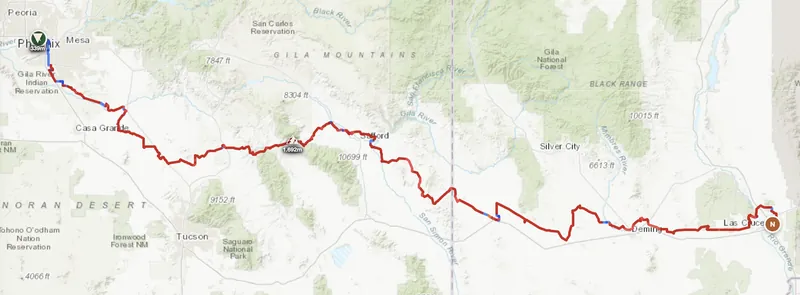
→From the Sonoran Desert at 339m, climbs the Gila Mountains to a peak of 1,692m, then drops into the Rio Grande Valley — 5,483m of cumulative climb, 4,557m of descent across the ride
→88% offroad, mostly dirt track. Long remote stretches around the AZ/NM border with 100+ km between fuel — plan conservatively and carry reserve
→Best ridden late October through March — desert cools off, the Gila high country is still rideable, and summer heat stays out of the low valleys
Arizona is the state that rewards being in the right place at the right elevation. The Sonoran Desert at 600m is rideable November through March — any other time the surface temperature cooks the tyres. The sky islands and the Mogollon Rim country at 2,000–3,000m flip that calendar: rideable April through October, snowed in most of the winter. Between them you have a state where somewhere is in season every month of the year.
The AZBDR is the obvious headline but the real Arizona is the network of forest service roads around Flagstaff, the Kaibab Plateau above the north rim of the Grand Canyon, and the sky-island ranges — Chiricahua, Santa Catalina, Huachuca — that rise 2,000m out of the desert in a single climb. You can start a day in saguaro cactus and end it in pine forest with an 8°C cooler ambient. No other state gives you that kind of vertical.
The Regions
The Mogollon Rim
1,800–2,400 m — central Arizona
The 300-km-long escarpment across the middle of the state. Pine forest up top, saguaro down below, and a dense network of forest roads connecting the two. Rideable May through October. Classic rim-road sunset rides above the clouds.
Kaibab & the North Rim
2,400–2,800 m — northern Arizona
The high plateau above the Grand Canyon's north rim. Cool even in July, closed by snow from roughly November to April. Remote — fewer towns, longer fuel gaps. The North Kaibab forest roads are the reward.
Sonoran Desert & Sky Islands
600–2,800 m — southern Arizona
Winter country. The desert floor is rideable October through April when the high country is too cold. Sky islands — Santa Catalina, Chiricahua, Huachuca — let you climb out of the heat when a late-season warm spell catches you out.
When to Ride
Jan
Feb
Mar
Apr
May
Jun
Jul
Aug
Sep
Oct
Nov
Dec
IdealPossibleAvoid
Arizona's riding year is inverted from the rest of the country — winter is the good season. October through April is when the desert is comfortable and the southern sky islands are clear. May is possible but hot; June–August the low country is genuinely dangerous. If you want to ride the high country (Flagstaff, Mogollon Rim, Kaibab), reverse it: May through October, with July–August bringing daily afternoon thunderstorms from the monsoon.
Regions to Plan Around
→Sky Islands · Southeast corner around Tucson. Desert floor and forested peaks (Chiricahua, Pinaleño, Santa Catalina) stacked on top of each other — climb to escape the summer heat. Rideable much of the year.
→Mogollon Rim & White Mountains · Central escarpment, dense forest-road network through Pine, Show Low, Alpine. May–October; July–August brings daily monsoon storms.
→Northern plateau · Flagstaff, Kaibab, Vermilion Cliffs — red-rock plateau at 2,000+ m. May–October; autumn is the best colour.
Practical
⛽ Fuel
Plan fuel on the AZBDR carefully — gaps of 150+ km between reliable stations are common in the north. Kaibab Plateau and the rim country have long empty stretches. Towns like Jacob Lake and Alpine have pumps but close early; 24-hour fuel is on the interstate corridors only.
💵 Currency
US dollars. Cards accepted in all towns. Carry cash for tribal park entrance fees (Navajo Nation, Hualapai) and for the occasional trading post where the till is a metal box.
🛂 Border
Internal US — no state formalities. The Navajo Nation and the Hualapai Reservation are separate jurisdictions inside the state with their own permit systems; entrance fees apply where marked. Mexican border is 30 km from Tucson — bring your passport if you plan to cross.
🏕 Overnight
Dispersed camping is legal on most Forest Service and BLM land — which is most of the high country. The Coconino, Kaibab, and Apache-Sitgreaves forests all permit free dispersed camping. Desert BLM land south of I-10 is popular with winter overlanders; arrive before 4 pm for shade.
📶 Signal
Worse than you expect outside metro Phoenix and Tucson. Flagstaff and Prescott have good coverage; ten minutes into the rim country you have none. Long empty stretches on the AZBDR. Satellite messenger is standard kit if you're riding solo.
🌡 Temperature
Phoenix in July: 45°C on the road surface. Flagstaff in July: 25°C with a chance of thunder. Same state, three hours apart. Winter flips it — Phoenix at 18°C, Flagstaff at -5°C with snow on the ground. Plan by elevation, not latitude.
Plan an Arizona offroad route
Set your start and end anywhere in the state — GoraAdv will route you through forest roads, rim country, and the sky islands instead of the interstate.