New Mexico is the quiet one. Sandwiched between Colorado's fame, Utah's photogenic red rock, and Arizona's sky-island wildness, it tends to get skipped — which is exactly why it rewards the people who ride it. The NMBDR is the least-trafficked Backcountry Discovery Route in the country. Average weekly riders on the route can fit in a pickup truck. The riding is good; the crowds simply haven't arrived.
The character is different from its neighbours. Northern New Mexico — Santa Fe, Taos, the Enchanted Circle — is Rocky Mountain South, with aspen groves and 3,500m passes that feel more Colorado than desert. Southern New Mexico is Chihuahuan Desert: higher, cooler, and emptier than the Sonoran. Between the two you have the Rio Grande rift valley, a 400-km corridor of extinct volcanoes and lava flows that the tourist circuit has never found.
Sangre de Cristo Mountains
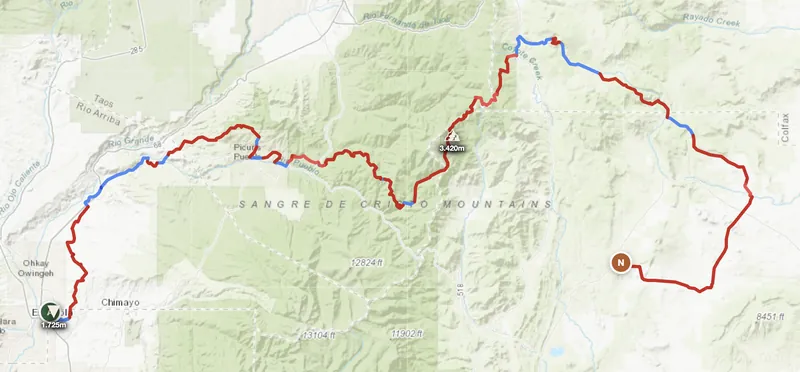
2,200–4,000 m — northern NM
The southernmost extension of the Rockies. Wheeler Peak is the state high point at 4,013m. Carson National Forest roads connect the old Spanish villages on either side. Rideable late May through early October; snow closes the high passes first.
Gila Wilderness Perimeter
1,800–2,700 m — southwest NM
The first federally designated wilderness in the United States (1924). You can't ride into the wilderness itself but the ring of forest roads around it is excellent — dense pine, canyon descents, and the historic route from Silver City north toward Reserve.
Rio Grande Rift Valley
1,400–2,000 m — central NM
The spine of the state. Volcanic cones, black-lava malpais, and back roads through villages the interstate skipped. Rideable almost year-round — cold in January, hot but not dangerous in July, and nearly traffic-free.
New Mexico rides best in the shoulder seasons. April–May and September–October are the sweet spots: the high passes are open, the desert is comfortable, and afternoon thunderstorms haven't started or have just stopped. July and August are the monsoon — rideable in the morning but you want to be off anything technical by noon. The high country (Sangre de Cristos, north end of the Gila) is out December through mid-April; the south and the rift valley stay rideable almost year-round with care.
⛽ Fuel
Gaps of 100–150 km are common on the NMBDR, and small-town pumps close by 8 pm. Santa Fe, Taos, Las Vegas (NM, not Nevada), Silver City, and Alamogordo are reliable. Plan the first and last fuel of each day carefully — especially in the empty stretch east of the Rio Grande.
💵 Currency
US dollars. Cards accepted in most places. Carry $50–100 cash for dispersed-camp fees, tribal park entrance fees (Jicarilla Apache, Acoma, several pueblos), and the small diners where the food is better than the card reader would suggest.
🛂 Border
Internal US. The Mexican border runs along the south edge of the state — don't wander too close to the fence on unmapped dirt roads unless you're ready to explain yourself to Border Patrol. Pueblo lands are sovereign jurisdictions; stay on public roads.
🏕 Overnight
Dispersed camping is legal on most Forest Service and BLM land — which covers a lot of the state. Carson, Santa Fe, Cibola and Gila National Forests all permit free dispersed camping with light restrictions. Stock up on water before heading up any forest road; creeks are seasonal.
📶 Signal
Patchy. Santa Fe, Taos, Las Cruces have good coverage; the mountains and the rift valley have almost none. NMBDR runs through long gaps. Satellite messenger recommended — the empty country is genuinely empty.
🌡 Temperature
Northern high country in July: 18–24°C days, 4°C nights at elevation. Southern desert in July: 35°C in the shade, rarely dangerous because of the altitude. Winter flips cold: Santa Fe gets snow, the high passes close. Layers matter more here than in most southwestern states.