The densest high-altitude track network in the United States. Mining roads, ghost towns, and forty-something named passes above 3,000m — most of them rideable on two wheels.
Imogene Pass · 3,962 mCOBDR · 1,086 kmBest: Jul – Sep58 peaks over 4,267 m
Featured Route
3 DaysWest to East Crossing
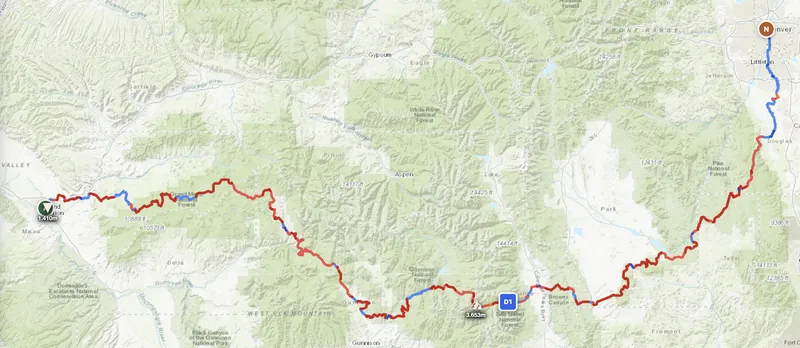
Grand Junction to Denver
Western Slope canyons → the Flat Tops → Gore Range → Front Range foothills · a full Colorado crossing at three-quarters dirt
→A full west-to-east crossing — from the mesa country above Grand Junction through the Flat Tops Wilderness edge, over the Gore Range, and down into the Front Range foothills
→Three and a half terrain zones in one trip: sagebrush desert (start), aspen high country, alpine tundra above treeline, then pine forest coming down to the Front Range
→Peak altitude sits at 3,653 m — ride it late June through early October. Earlier and snow gates the high sections; later and the first snow catches you
Colorado is what every adventure rider pictures when they hear "the American West" — high alpine passes above treeline, ghost towns at the end of mining roads, aspen forests turning yellow in September, and a state-long track network built over 150 years by silver miners, ranchers, and the US Forest Service. The southern San Juan Mountains alone hold more passes above 3,500m than most countries have at any altitude.
It's also the state where the Backcountry Discovery Routes idea started. The COBDR — 675 miles from the New Mexico border to Wyoming — is the route every ADV rider in the US has heard of, and it deserves the reputation. But the real reason to ride Colorado is that you can leave the BDR line almost anywhere and find another legal dirt road going in roughly the right direction. The network is that dense.
The Passes
Imogene Pass
3,962 m — between Ouray and Telluride
One of the highest drivable passes in the United States and arguably the most famous jeep road in Colorado. Narrow, rocky, genuinely difficult — this is not a beginner's pass. The top is alpine tundra with zero shelter. If a thunderstorm moves in you want to be either already over the top or back down. Open roughly July through early October.
Engineer Pass
3,871 m — the Alpine Loop north leg
Part of the classic Alpine Loop between Lake City, Silverton and Ouray. Rougher and more remote than the paved Million Dollar Highway a few valleys over. The north side down toward Henson Creek is the steep, washed-out, beautiful side — expect loose rock and a few tight switchbacks.
Ophir Pass
3,563 m — Silverton to Telluride shortcut
The gentler option between Silverton and Telluride. Short, scenic, mostly wide enough for two-way traffic. A good first high-altitude pass if you're new to the state — the views rival Imogene but the exposure and the technical difficulty are both a notch lower.
When to Ride
Jan
Feb
Mar
Apr
May
Jun
Jul
Aug
Sep
Oct
Nov
Dec
IdealPossibleAvoid
Most of the high passes don't open until late June or early July — snowpack above 3,500m is the limiting factor, not calendar date. Check pass status before committing to a plan. July and August bring daily afternoon thunderstorms (the North American Monsoon): be over the top of anything exposed by noon, down to treeline by 2 pm. September is the exceptional month — stable weather, empty roads, aspen turning gold. October works until the first big storm closes the high passes, usually somewhere between the 10th and the 25th.
Regions to Plan Around
→San Juans — high passes · 3,000–4,300 m, concentrated in the southwest corner around Ouray, Silverton, and Telluride. The densest high-pass riding in the country. July through early September; snow closes the passes by mid-October.
→North Park & the Rabbit Ears · Walden-area basins and long gravel spines between Steamboat and the Wyoming line. Cold, empty, open. Prime June through September.
→Front Range foothills · Denver-adjacent, lower elevation, longest season. Dense network of forest roads west of Fort Collins through Colorado Springs. April through November most years.
Practical
⛽ Fuel
Stations are reliable in every town — Durango, Silverton, Ouray, Lake City, Gunnison, Salida all have pumps. Gaps between stations in the high country can reach 100 km on dirt, so top up any time you pass one. Many small-town pumps close by 8 or 9 pm.
💵 Currency
US dollars. Cards accepted nearly everywhere except the smallest mountain outposts — carry $50–100 cash for fuel pumps that don't read foreign cards and for campground fees, which are usually exact-change envelope systems.
🛂 Border
Internal US — no state border formalities. If you're flying in with a foreign licence, check that it's valid for the rental company; an International Driving Permit is cheap insurance.
🏕 Overnight
Dispersed camping is legal and free on most US Forest Service and BLM land — which covers a huge share of the high country. Hotels in Ouray, Telluride and Crested Butte are expensive in season (Jul–Sep) but Silverton and Lake City stay reasonable.
📶 Signal
Patchy to nonexistent across most of the San Juans and the Sangre de Cristo range. Valley towns have full coverage; two hours up a pass you have none. A satellite messenger is not optional on the COBDR — it's the standard tool.
🌡 Temperature
Valley floors in July sit at 20–28°C; pass summits at 3,900m can be 5–10°C with wind chill even in full sun. Snow squalls in July are rare but possible. Pack mid-layers and waterproofs regardless of the forecast — altitude overrides the weather app.
Plan a Colorado offroad route
Set your start and end anywhere in the state — GoraAdv prefers dirt over pavement and will route you through the highest rideable passes the season allows.