Featured Route
Why Adventure Riding in Estonia
Estonia is 45,000 km² of forest, bog and coast. It is almost entirely flat — the highest point reaches 318m — and roughly half the landmass is covered in pine, spruce and birch. 22% of the country is protected land. The population is 1.3 million people, most of them in Tallinn, which means everything south and east of the capital is essentially empty.
For offroad riding this translates into one of the densest gravel-road networks per capita in Europe. Forestry tracks, agricultural roads, bog boardwalks — the RMK (state forest management) maintains a legally-ridable web of service roads that connects the whole country. It's also the easiest offroad terrain in the GoraAdv set: no rocks, no altitude, no heat, no border paperwork. A perfect first-time ADV country.
The Regions
Estonia's oldest national park, north of Tallinn — glacial boulder coastline, 19th-century manor houses and dense spruce forest. The gravel back roads between Loksa and Palmse are the classic weekender from the capital.
A 400 km² mosaic of raised bogs, flooded forest and single-track service roads in the west-central lowlands. In spring the "fifth season" floods most of the park — summer gives dry, hard-packed peat tracks that feel like rolling through a Tolkien illustration.
3,500 km² of lake shared with Russia. The Estonian western shore is a chain of Old Believer fishing villages, onion fields and reed-bed gravel roads. Finish a traverse at Mustvee, eat smoked perch, ride back on a different line.
When to Ride
April in Estonia is mud season — the bogs flood and forest tracks are impassable until the ground firms up in mid-May. The real window is May to early September: daylight stretches to 18 hours in June ("white nights"), temperatures sit in the 18–25°C range, and the gravel is firm. Midsummer (Jaanipäev, June 23) is the cultural peak if you want to see every Estonian drunk in a field. October is rideable but increasingly wet and dark. From November the first snow shuts down the forest network until April.
How to Fit It Into Your Route
- → Baltic loop: Estonia → Latvia → Lithuania — the three-country week. Ferry into Tallinn, traverse to Tartu, cross into Latvia via Valga, ride through the Gauja NP and finish in Vilnius or back to Tallinn. 7–10 days, almost entirely on gravel.
- → Finland ferry combo — Helsinki–Tallinn ferry runs every 2 hours. Use Estonia as the southern warm-up or cool-down to a Finnish Lapland trip. The flat forest riding is a useful shake-down before committing to the remoter north.
- → Tallinn weekender — fly in, rent a bike, do Lahemaa + central forest loops. Compact enough for 3 days without moving hotel every night. The cheapest European offroad city-break.
Practical
Reliable in every town, but the forested interior can go 60–80 km without a pump. Fill up before leaving any major road. Prices track the EU average; all stations accept cards.
Euro. Cards are accepted everywhere — Estonia is one of the most cashless societies in Europe. You can ride the whole country without touching a coin, including rural petrol pumps.
EU and Schengen — no checks from Latvia or via Finnish ferry. The Russian border east of Lake Peipus is closed to tourist traffic; do not attempt. Narva is the only road crossing and is effectively frozen.
State forest (RMK) campsites are free, well-maintained, and dotted every 20–30 km through the forested interior — firewood and pit toilets provided. Guesthouses ("majutus") in villages are cheap (30–50 EUR). Wild camping is legal on public land under the "everyman's right".
Excellent — Estonia has one of the best mobile networks in the world. 4G covers essentially the entire country including the forested interior and Lake Peipus shore. The only dead zones are in the deep Soomaa bogs.
Mild Baltic summers — 18–25°C is typical, rarely above 30°C. Rain is common and tracks can stay wet for days after a front passes. Bring waterproofs even in July; the forest will shrug off a shower faster than you will.
Plan an offroad route in Estonia
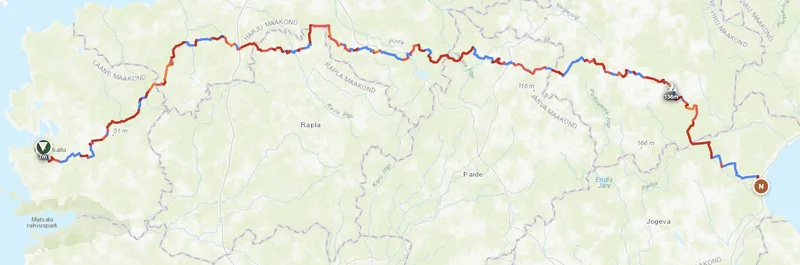
Set your start on the Baltic coast and finish at Lake Peipus — GoraAdv routes you across Estonia on state forest gravel and bog service roads.
Open the Planner →