Featured Route
Why Adventure Riding in Latvia
Latvia is 64,600 km² of pine forest, farmland and low hills — the highest point reaches 312m. The country is roughly split into four historical regions: Kurzeme (west), Zemgale (central plain), Vidzeme (centre/east, where the Gauja rises) and Latgale (eastern lakes). Forest cover is 52%. Population is under 1.9 million and falling, most of it in Riga.
That population sparsity is what makes Latvia work for ADV. The road network is almost entirely unpaved outside the A-roads — over 50,000 km of registered gravel roads, many of them effectively single-track forest service trails. There are no weight restrictions, no toll system, no vignette. For a rider, it's one of the freest countries to move around in Europe.
The Regions
The western region between the Baltic and the Venta river. Deep pine forests, empty beaches, and the Cape Kolka tip where the Gulf of Riga meets the open Baltic. Gravel networks here are the quietest in the country — you can ride 30 km without seeing another vehicle.
Latvia's oldest and largest national park, 90,000 hectares centred on the Gauja valley. Red-rock sandstone canyons, medieval castle ruins, and gravel forestry roads that wind down to river crossings. The most scenic single region in the country.
The country's eastern extremity — a Russian Orthodox heartland of Old Believer villages, onion fields, and lake-dotted forest. Gravel connectors between lakes give a different riding rhythm: shorter sections, more variety, frequent ferry-style water features.
When to Ride
April is thaw month — bogs flood, clay roads turn to soup. The window opens in mid-May once the ground firms up. Summer (June to August) is warm but never hot — 20–25°C typical, afternoons sometimes stormy. The sweet spot is June (white nights, 18 hours of daylight) and September (dry, cool, golden birch forests). October is marginal: rideable but wet, dark, and the first snow usually arrives by month's end. November through March the forest network is closed by snow.
How to Fit It Into Your Route
- → Baltic trilogy: Estonia → Latvia → Lithuania — the three Baltic states in one trip. Ferry into Tallinn, traverse south through Gauja NP, finish in Vilnius or loop back via Kurzeme. 10 days, mostly offroad, one currency, no border checks.
- → Riga weekender — fly into Riga, rent a bike, day-loop into Gauja NP (Sigulda/Cēsis) on gravel. 2 days, no border hopping. The easiest offroad city-break in the EU.
- → Baltic coast-to-Finland combo — ride the Kurzeme coast north to Tallinn, ferry to Helsinki, continue into Finnish Lapland. Latvia's flat forests work as the warm-up before the remote north.
Practical
Adequate on main roads. The forest interior between Kurzeme and Latgale can go 80–100 km between pumps — plan top-ups in any town you pass. Prices track the EU average.
Euro. Cards work in towns and at chain petrol stations; cash is occasionally needed for small rural pumps, guesthouses and mushroom-sellers at the roadside.
EU and Schengen — open crossings from Estonia and Lithuania. The Russian border at Zilupe and the Belarus border south of Daugavpils are closed to tourist traffic.
Guesthouses ("viesu māja") in every village at 25–45 EUR. Wild camping is tolerated on public forest land under "everyman's right". State forest picnic sites with fire pits dot every major gravel route.
Good to excellent nationwide — among the best coverage in the EU. Rare dead zones in the deepest Gauja canyons and far-eastern Latgale. Offline maps still worth downloading for forestry-track navigation.
Mild Baltic summers — rarely above 28°C, often below 20°C. Rain is common; clay-based forest tracks become slippery for 6–12 hours after a shower but drain faster than they look. Pack waterproofs in all summer months.
Plan an offroad route in Latvia
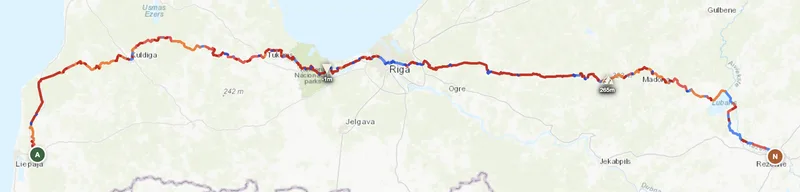
Set your start on the Kurzeme coast and finish in Latgale — GoraAdv routes you across the full country on forestry and agricultural gravel.
Open the Planner →