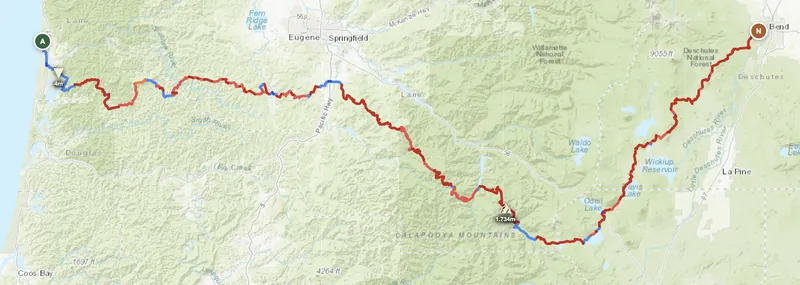
Oregon is the state that splits in two down the Cascade crest. West of the mountains is temperate rainforest — green, wet, and wrapped in a dense network of logging roads that open up some of the best single-track-gradient riding in the country. East of the mountains the state becomes high-desert sage and rim-rock country, with long empty BLM roads connecting small ranching towns and the kind of horizon you only find in the Great Basin. Almost no other state gives you both ecosystems in a single day's ride.
The ORBDR crosses Oregon twice, covering roughly 1,250 km from California to Washington. Beyond the BDR, the Cascade crest is laced with forest service roads reaching Mt Hood, Mt Jefferson, and the Three Sisters. Further east, the Ochoco, Malheur, and Fremont-Winema national forests are some of the least-trafficked public land in the lower 48. If you want quiet dirt, Oregon still has it.
Coast Range & Pacific
0–1,200 m — western Oregon
Dunes at Florence, dense coastal rainforest above. Logging-road density is extreme — old gravel spurs and decommissioned tracks for days. Rideable most of the year but wettest November–April; July–September is the dry window.
Cascade Crest
800–3,400 m — central Oregon
Mt Hood, Mt Jefferson, the Three Sisters. Forest service roads on both flanks with dozens of passes and viewpoints. Opens mid-June as snow clears, closes with the first October storm. August–September is peak season.
Eastern High Desert
1,000–2,300 m — eastern Oregon
Ochoco, Malheur, and the Steens Mountain country. Long empty BLM roads, sage flats, and rim-rock canyons. Rideable May–October with a heat gap in July–August when water becomes the limiting factor.
Oregon has a shorter high-country season than the states to the south. The Cascade passes hold snow into mid-June and start closing again in October. June through September is the reliable window across the whole state. July and August bring fire season — smoke can make eastern valleys unrideable some years. The cleanest weather is typically the last two weeks of September: low fire risk, dry trails, and the summer crowd gone.
⛽ Fuel
Oregon is one of only two states where pumping your own fuel was historically restricted, though rules have relaxed. Plan on limited rural hours — east-side towns like Paisley, Fields, and Frenchglen can have 150+ km gaps. Carry an extra can on the ORBDR.
💵 Currency
US dollars. Oregon has no sales tax, which is a quiet perk for anyone buying gear mid-trip. Cards work in towns; bring cash for rural diners, dispersed-camp fees, and the occasional general store east of the Cascades.
🛂 Border
Internal US — no state formalities. The Columbia River crossings to Washington are all free and fast. Crossing into California on I-5 or along the Siskiyou backroads is equally simple.
🏕 Overnight
Dispersed camping is legal on most national forest and BLM land — which is most of eastern Oregon and large parts of the Cascade flanks. Developed campgrounds fill fast in July and August near Bend, Sisters, and the Mt Hood area; the forest around them rarely does.
📶 Signal
Strong along I-5 and I-84. Patchy in the Cascade forests, nonexistent across most of the eastern high desert. Steens, the Alvord, and the Fremont-Winema are effective dead zones — a satellite messenger is standard for the ORBDR east of the Cascades.
🌡 Temperature
Coast and Willamette Valley are mild year-round — 15–25°C in summer. Cascade passes can be 10°C cooler. Eastern high desert swings hard: 35°C in afternoon summer, near freezing at night above 1,500m. Pack for three climates if you're crossing the whole state.