The Frank Church-River of No Return Wilderness sits at its centre — the largest roadless area in the lower 48. You can't ride into it, but you can ride around it, and the surrounding country is some of the best in the country.
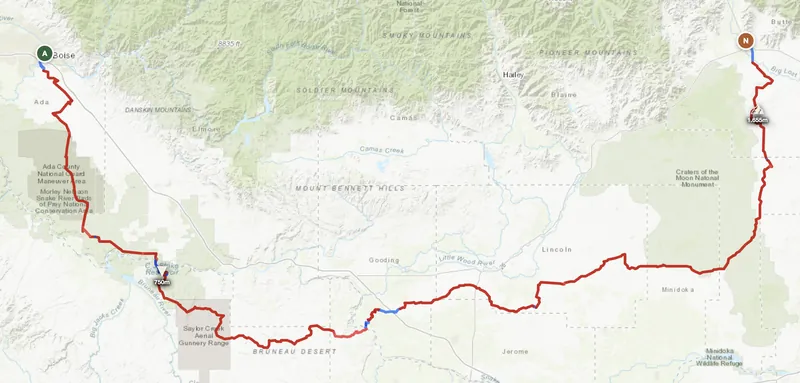
→93% offroad — almost entirely dirt tracks through the Owyhee Desert, Snake River canyon lands, and the sagebrush plains west of Craters of the Moon
→High-desert riding at its finest — long sightlines, open two-tracks, almost no traffic. The finish at Arco skirts one of the largest lava fields in North America
→Summers hit 35°C+ on the plains — ride early, carry extra water, and plan fuel carefully. Late May through early October is the window; mid-September is ideal
The Frank Church-River of No Return Wilderness is the largest roadless area in the lower 48 — nearly 1 million hectares. You cannot ride into it; the entire wilderness is pedestrian-only. But the roads that surround it are some of the best in the country, and they define Idaho adventure riding. The IDBDR is the longest of the BDR routes at 2,000 km, running border-to-border through the Sawtooths, the Salmon River canyon, and the Clearwater forests.
Idaho rewards the rider who plans carefully. Fuel gaps of 150+ km are common, and smoke from regional wildfires can make August unreliable. But September and early October offer the exceptional window — stable weather, golden larch, the roads to yourself, and the Frank Church wilderness as a permanent backdrop.
The Regions
Sawtooth Range
1,900–3,200 m — central Idaho
Granite spires, Stanley basin, densest high-country riding in the state. A loop network of passes and ridgeline roads. Snowpack often holds in the Sawtooths until early July; the season is short (July through mid-October) but exceptional. Thunderstorms are frequent in August; September is the stable window.
Salmon River & Frank Church Perimeter
1,000–2,500 m — central Idaho
The wildest riding in the state. The Salmon River runs the spine and is undammed — the deepest canyon in North America (Hells Canyon) is nearby. Fuel is sparse; the next pump after Stanley is 200+ km downriver. Rideable June through October with July-August smoke a potential issue.
Idaho Panhandle & Clearwater
600–2,000 m — north Idaho
Forested, wetter than the Sawtooths. The Clearwater National Forest has a dense road network and extends the riding season earlier (June) and later (November) than the mountains. More rain, fewer fuel gaps, less dramatic scenery — but the season is longest here.
When to Ride
Jan
Feb
Mar
Apr
May
Jun
Jul
Aug
Sep
Oct
Nov
Dec
IdealPossibleAvoid
Snowpack often holds in the Sawtooths until early July; high passes are safe mid-July through mid-October. August is the thunderstorm month and regional wildfire smoke can reduce visibility significantly. September and early October are the exceptional window — stable weather, golden larch, nearly empty roads, and enough season left for a long multi-day ride without being rushed. The Clearwater and Panhandle sections extend the season at lower elevations (rideable in May and November) but the high country dominates the riding experience.
Regions to Plan Around
→Sawtooth & Stanley Basin · Central Idaho around Stanley. High granite country, hot-spring campgrounds, three major passes within a day of each other. July–September.
→Frank Church–Salmon River perimeter · The dirt ringing the largest wilderness in the lower-48. You ride around it — the core is closed to bikes. Long single-lane canyon roads above the Salmon. June through October on the flanks.
→Panhandle & St. Joe · Northern Idaho, the wettest riding in the state — dense forest, old logging spine roads, frequent small towns. June through October, expect afternoon rain even in August.
Practical
⛽ Fuel
Long gaps along the Salmon River and in the Sawtooths — 150+ km common, some stretches 180+ km. Top up at every town and never assume a station is open. The next pump after Stanley is 200+ km downriver; plan accordingly or cache fuel.
💵 Currency
US dollars. Cards work in Stanley and Salmon but remote cabins and guest ranches often expect cash. Carry $150–200 for multi-day stretches without town access. Hot-spring campgrounds (Stanley Hot Springs, etc.) are cash-only.
🛂 Border
Canadian border in the north via the Panhandle routes; passport required for any crossing. The IDBDR does approach the border but doesn't require crossing unless extending into British Columbia. Internal US — no state border formalities elsewhere.
🏕 Overnight
Dispersed camping on USFS/BLM is the standard free option and is abundant. Hot-spring campgrounds (Sunbeam, Stanley, Bonneville) are organized and seasonally crowded but worth the $15–20 fee. Most high-country sites are first-come-first-served.
📶 Signal
Town-only. The river canyons and Frank Church perimeter have no coverage. Stanley and Salmon have good signal; everything in between is unreachable. Satellite messenger is standard kit for any multi-day ride here — it's not optional.
🌡 Temperature
Basin floors sit at 25°C July days; pass summits at 3,000m are 10°C, dry heat. Smoke season August–September can reduce visibility significantly and air quality impacts both rider and machine. Pack dust masks and plan shorter riding days if smoke is present.
Plan an Idaho offroad route
Set your start and end anywhere in the state — GoraAdv prefers dirt over pavement and will route you through the Sawtooths, the Salmon River, and the Frank Church perimeter.