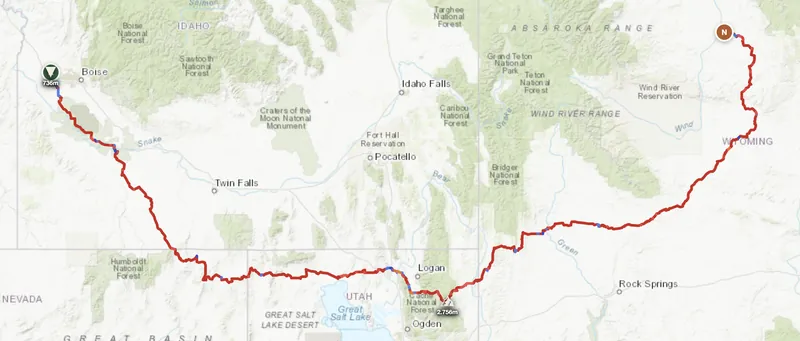
→A west-to-east expedition — crosses four distinct landscapes (Snake River Plain, Tetons, Wind Rivers, high plains) with 95% of the route on dirt
→Long remote sections — some days without a town, 200+ km between reliable fuel. Plan each day with a firm end point and a backup; sunset on the high plains arrives fast
→Only rideable mid-July to mid-September — the Wind River passes hold snow into July and afternoon thunderstorms over the exposed high plains can be violent
Wyoming is empty in a way that's hard to describe until you drive across it. Fewer than 600,000 people spread across 480,000 square kilometres — that's roughly the population density of Montana but compressed into a state that feels half the size. You can ride for entire days without seeing a settlement, and the riding connects three distinct mountain ranges (Bighorns, Wind River, and the Absaroka-Beartooth) via high plains that roll for 150+ km between fuel stops.
The WYBDR is the backbone, but it's the isolation that defines Wyoming riding. Long fuel gaps mean you plan water and food carefully. Afternoon thunderstorms develop from clear skies in less than 20 minutes. Snow stays on the Bighorns longer than anywhere else in the southern Rocky Mountain chain. But the reward is a 1,500 km loop through country that genuinely feels untouched.
The Regions
Bighorn Mountains
2,400–4,000 m — north-central Wyoming
The dominant range, bisecting the state north-to-south. Dense forest-road network, snow stays longest here (June starts rideable, high passes may not clear until July). US-14A and the Medicine Wheel Loop are the headline routes. Closes mid-October with the first serious storm. Rideable June through October with July-August being the peak.
Wind River Range
2,100–4,200 m — west-central Wyoming
The highest peaks; the range is mostly wilderness. Perimeter riding only — Togwotee Pass is the gateway. Gannett Peak (4,207m) is the tallest peak; you cannot ride to it but you ride around it. Open mid-July to early October; high passes June-ready but snow lingers on the exposed north faces.
High Plains & Red Desert
1,800–2,400 m — east and south Wyoming
Open, historic, rideable longer than the mountain ranges. The Red Desert has no shade and fuel gaps exceed 200 km — it's the defining challenge of the southern WYBDR. Rideable April through November, best May and September-October. July-August heat and dust make longer days punishing.
When to Ride
Jan
Feb
Mar
Apr
May
Jun
Jul
Aug
Sep
Oct
Nov
Dec
IdealPossibleAvoid
Snow on the Bighorns doesn't clear until late June; high passes are safe mid-July to mid-October. July and August bring afternoon storms, and lightning is a real risk on the exposed plateaus and ridgelines. September is the exceptional month — stable weather patterns, cottonwoods turning yellow, nearly empty roads, and fuel stations still staffed (some close after Labor Day). The Red Desert extends the season (April-May, October-November) but summer is the peak window for a long multi-day crossing of the state.
Regions to Plan Around
→Wind River perimeter · West-central Wyoming, the dirt ringing the highest range in the state. You ride the flanks — the core is wilderness and closed to bikes. July–September, snow lingers late on the north passes.
→Bighorns · North-central, between Sheridan and Cody. Dense network of forest roads climbing to 2,700m plateaus with long open sightlines. Mid-June through September.
→Red Desert & Great Divide Basin · South-central, the high cold desert between Rock Springs and Rawlins. Long, empty, exposed — huge fuel gaps. Rideable May through October; avoid midsummer heat on the open crossings.
Practical
⛽ Fuel
Fuel gaps are the longest in the contiguous US — 200+ km between stations in the Red Desert; the Bighorns have gaps of 100+ km. Top up any time you see a pump. Most stations in small towns close by 8 pm; schedule accordingly and never assume a station is open.
💵 Currency
US dollars. Cards work in towns but cash is essential for dispersed-camp envelopes, backcountry ranch gates, and the occasional remote general store. Carry $150–200 for multi-day remote stretches.
🛂 Border
Internal US — no state border formalities. Canadian border lies 400+ km north via Montana. The northern WYBDR sections approach the Absaroka-Beartooth range but don't cross into Canada; however, some northernmost routes may approach the border — carry a passport.
🏕 Overnight
Dispersed camping is legal on BLM and USFS land, which covers a massive footprint in Wyoming. Organized campgrounds near towns fill during July-August but dispersed sites are almost never crowded. Many developed camps are first-come-first-served.
📶 Signal
Town-only in the Red Desert and remote valleys. The Bighorns have moderate coverage along main drainages but the peaks are dead zones. A satellite messenger is standard kit for any multi-day ride here — it's not optional.
🌡 Temperature
Basin floors hit 30°C in July; high passes at 3,500m sit at 10°C in the same week. Frost is possible overnight at elevation even in July. A 20°C difference over 1,500m of climb is typical — pack waterproof outer layer, insulating mid-layer, and base layers.
Plan a Wyoming offroad route
Set your start and end anywhere in the state — GoraAdv prefers dirt over pavement and will route you through the Bighorns, the Red Desert, and the Wind River perimeter.