Big Sky country, the Bob Marshall wilderness perimeter, and the highest non-paved passes outside Colorado. The state where 'remote' actually means remote.
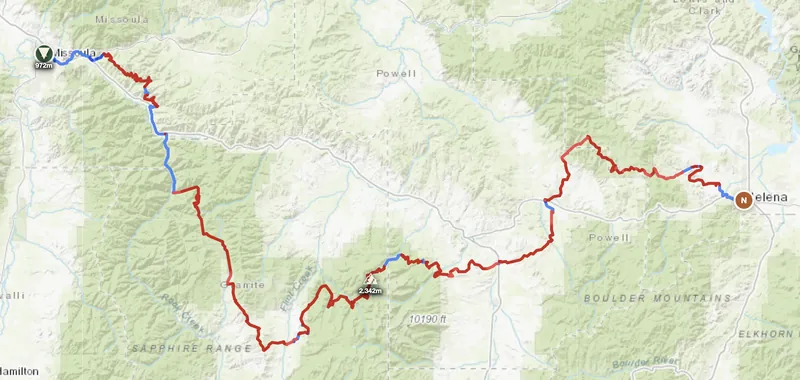
→Climbs east out of Missoula into the Garnet Range — an old gold-mining country of dirt tracks, ghost towns, and long views back over the Blackfoot valley
→79% offroad over two days, peaking at 2,342m — steep dirt, exposed ridges, and a few technical descents. A capable rider and a loaded bike both get a workout
→Best July through mid-September once the passes clear. Fuel at Missoula, Ovando, and Helena — nothing reliable in between, so top up at every chance
Montana is the definition of 'remote.' With fewer than a million people spread across 380,000 square kilometres, you can ride entire days without seeing a settlement. The Beartooth Plateau climbs to 3,337m and the MTBDR connects the three largest roadless areas in the lower 48 — the Bob Marshall Wilderness Complex, the Greater Yellowstone Ecosystem, and the Absaroka-Beartooth Range.
The trade-off is short season. High-country snow doesn't clear until mid-June, and the first serious storms arrive by mid-September. But those three months are exceptional — empty roads, stable weather patterns (mostly), and the kind of isolation that makes a two-week loop feel like you've left the country entirely.
The Regions
Beartooth Plateau
2,500–3,400 m — south-central Montana
The high country. The Beartooth Pass crosses the spine at 3,337m and the entire plateau is above 2,500m with glaciers, alpine tundra, and passes that close with the first October storm. Open mid-July to late September — the soonest you can ride it in June, the latest you can expect to cross reliably is October 1.
Bitterroot & Bob Marshall
1,200–2,500 m — central Montana
The largest roadless area in the lower 48 sits in the middle of the state. You can't ride into it but the perimeter roads are some of the emptiest in the US — the MTBDR runs the eastern face of the Bitterroot, then climbs to the Bob Marshall foothills. Rideable June through September with occasional snow into mid-June.
Missouri Breaks & Glacier Foreland
600–2,000 m — north-central Montana
Badlands, glacial valleys, and the longest riding season in the state. The Missouri Breaks sit below 1,500m and are rideable April through November. The Glacier Foreland near the Canadian border gets snow but extends the season at lower elevations — the northern MTBDR section is passable as early as May.
When to Ride
Jan
Feb
Mar
Apr
May
Jun
Jul
Aug
Sep
Oct
Nov
Dec
IdealPossibleAvoid
High-country snow doesn't clear until mid-June; July-August brings afternoon thunderstorms with lightning risk on the exposed plateaus. September is the exceptional month — stable weather, larch turning gold, empty roads, and enough season left to make multi-week rides possible without being rushed. The northern sections (Glacier Foreland, Breaks) open earlier — May is possible — but the high passes remain snow-blocked until June 15 or later in heavy-snow years.
Regions to Plan Around
→Bob Marshall perimeter · Northwest Montana, the Continental Divide wilderness block and the dirt that rings it. One of the largest roadless areas in the lower 48 — you ride around it, not through. Long season for Montana: July–October.
→Beartooth & Absaroka · South, east of Yellowstone. Alpine plateau and deep-valley forest roads from Red Lodge to Cooke City. The Beartooth itself is paved, but the dirt flanking it is serious high country. July–September, shoulder dates gamble on snow.
→Pioneer & Big Hole · Southwest Montana, between Butte and the Idaho line. Quieter ranges with long gravel spines, good rider infrastructure in the small mining towns. July through October.
Practical
⛽ Fuel
Fuel gaps of 100+ km are common in the Bob Marshall and the Missouri Breaks. Small-town pumps often close early (6–7 pm); ensure you top up at every opportunity. The Beartooth section has more frequent stations but they still close early — plan accordingly.
💵 Currency
US dollars. Cards work in towns but cash is essential for dispersed-camp envelopes, backcountry cabins, and ranch gates. Carry $100–150 in small bills for areas where pump attendants expect exact cash for remote stations.
🛂 Border
The northern MTBDR reaches the Canadian border at Glacier National Park. Passport required. The park's internal roads (e.g. Going-to-the-Sun Road) are paved-only. Plan international crossings (if any) for daylight hours and known border crossings.
🏕 Overnight
Dispersed camping is legal on most USFS and BLM land — Montana has a massive footprint of both. Grizzly-bear country rules apply: store food in bear-proof containers, cook away from camp, and carry bear spray. Organized campgrounds near towns fill during July-August.
📶 Signal
Almost none outside towns. The Bob Marshall Wilderness Complex is entirely unreachable. Satellite messenger is standard kit on the MTBDR — it's not optional, it's essential. Towns like Livingston, White Sulphur Springs, and Lewistown have coverage but anywhere remote does not.
🌡 Temperature
Valley floors sit at 25°C in July days; pass summits at 3,300m are 5–10°C with intense wind. A 20°C swing over 1,500m of climb is typical. Pack waterproof outer layer, fleece, and a base layer — weather changes in minutes at altitude.
Plan a Montana offroad route
Set your start and end anywhere in the state — GoraAdv prefers dirt over pavement and will route you through the Beartooth, the Bob Marshall perimeter, and the high country in between.