Featured Route
Why Adventure Riding in Uruguay
Uruguay is the smallest Spanish-speaking country in South America (176,000 km²) and arguably the most underrated for ADV. The whole country is rolling pampa with the occasional low ridge — no real mountains, no proper desert, no jungle. What it does have is one of the densest rural dirt-road networks anywhere on earth, an Atlantic coast of empty beaches and lagoons, and a settled gaucho-ranching culture where every dirt track leads somewhere with a person who'll greet you. Population density is just 19 people per km² — emptier than Wyoming.
For ADV riders, Uruguay is the easiest South American country to ride and the warmest welcome you'll get on the continent. Distances are short (the cross-country traverse is only 600 km), the road network is dense, fuel is everywhere, and Uruguayans treat foreign motorcycle travelers exceptionally well. The whole country can be toured comprehensively in 7–10 days. Best paired with Argentina or Brazilian Sul as a connector — Uruguay alone might not be a destination, but combined with neighbouring rides it's a perfect quiet middle.
The Zones
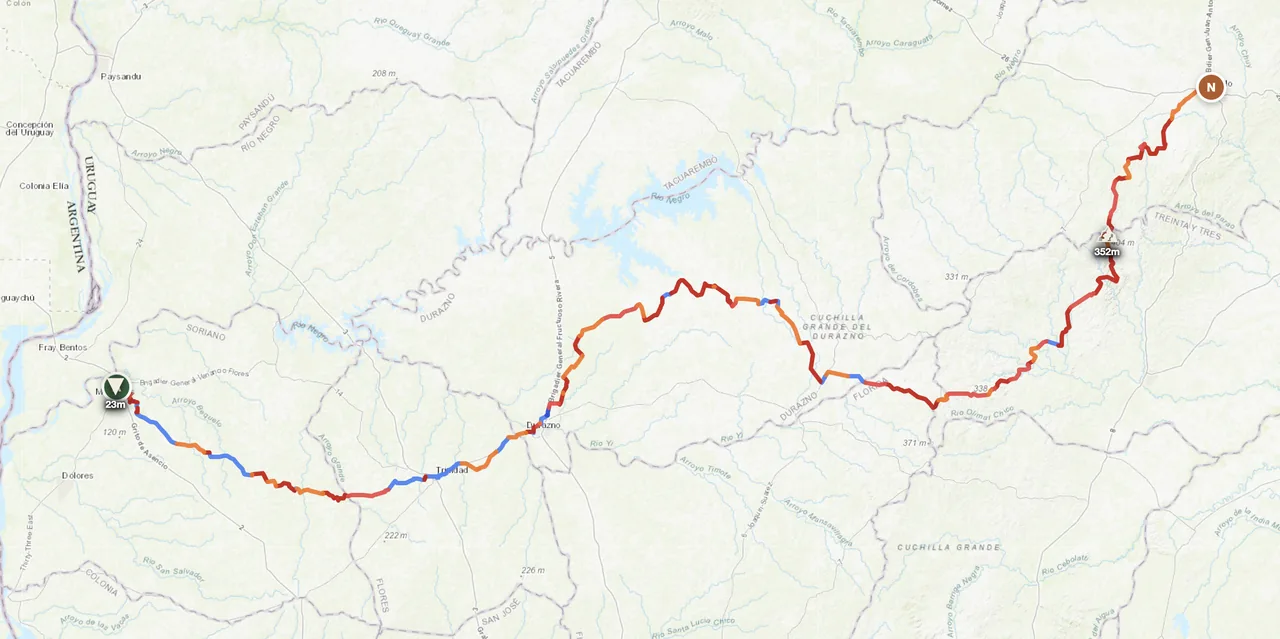
The riding heart. Rolling grasslands at 100–250 m altitude, dense rural dirt-road network, ranching estancias, small interior towns at 50 km intervals. Year-round rideable; summer (Dec–Feb) gets hot and humid, winter (Jun–Aug) is mild and cool. The featured route covers this zone end-to-end.
Empty beaches stretching from the Río de la Plata estuary to the Brazilian border. Dirt connectors run parallel to the coastal Ruta 9 through fishing villages, dunes and the wild Cabo Polonio reserve. Best Nov–Mar (austral summer); shoulder seasons quieter and cooler.
The northern interior — low quartzite ridges, basalt outcrops, gaucho heartland with a strong Brazilian cultural overlap near the border. The most "remote" Uruguay gets, with longer dirt stretches between settlements. Year-round rideable.
When to Ride
Uruguay is one of the rare countries with no genuine "avoid" months. The climate is mild year-round — temperate maritime moderated by the Río de la Plata. Summer (Dec–Feb) is warm-humid 25–32°C with afternoon thunderstorms; austral autumn and spring (Mar–May, Sep–Nov) are ideal — clear days, cool nights, dry roads. Winter (Jun–Aug) is mild (10–18°C) with occasional cold rain; rideable with proper layers. The featured route's Easy difficulty holds across all seasons, just adjust pace and gear.
Regions to Plan Around
- →Cross-country dirt traverse — The featured Mercedes → Melo route. 3 days, 81% offroad, perfect bridge between Argentina and Brazil. Best Sep–May.
- →Atlantic coast loop — Montevideo east through Punta del Este, La Paloma, Cabo Polonio to Chuy on the Brazilian border. 3–5 day coastal loop with dirt connectors and beach access. Best Nov–Mar.
- →Northern hills loop — Tacuarembó as base, ride the Cuchilla de Haedo and Quebrada de los Cuervos. 3–5 day ranch-country loop with the longest dirt stretches Uruguay offers. Year-round rideable.
Practical
Stations dense by South American standards — every town has fuel, longest gaps in the rural interior are 80–100 km. ANCAP is the dominant brand with the most rural reach. Premium 95 widely available; 87 standard everywhere. Fuel quality is consistently good.
Uruguayan peso (UYU). Cards work in cities and most highway-corridor towns; cash dominant in rural interior. ATMs reliable in all towns of any size. USD is widely accepted at touristy spots (Punta del Este, Colonia) at reasonable rates.
Visa-free for most western passport holders for 90 days. Vehicle import (TIP) at land borders is straightforward — Argentine crossings (multiple along the Río Uruguay), Brazilian crossings (Chuy, Rivera, Aceguá) all open. Insurance via local SOAT or international card.
Estancias welcome riders with secure parking and meals — a uniquely Uruguayan experience. Hostels and posadas in towns. Camping is legal on the coast in designated areas; wild camping in the interior is fine with landowner permission. Cities have proper hotels at reasonable prices.
Coverage is excellent — Uruguay has near-complete cellular coverage country-wide thanks to its small size and dense settlement. Even rural interior dirt has signal in 90%+ of locations. Satellite messenger nice-to-have but not essential here.
Mild temperate climate moderated by the South Atlantic. Summer (Dec–Feb) 25–32°C with humid evenings; winter (Jun–Aug) 8–18°C with occasional cold fronts. Coast is windier than interior. Pack a light waterproof and warmer layer regardless of season.
Plan a Uruguay traverse
Set your start at Colonia or Mercedes and end at the Brazilian border — GoraAdv routes you across the rolling pampa interior on rural dirt, automatically.
Open the Planner →